

The Import contacts screen
Short answer
Add from CSV opens a full-screen importer with three steps: Upload, Map fields, and Segment. Each step asks one thing, and × at the top right leaves without importing anyone.
The screen fills the window while you import. The bar at the top reads Back, then Import contacts, with × at the top right. Once you’ve uploaded a file, the three steps show in the middle of the bar.
On the first step, Back leaves the screen, as × does. After that, it goes back a step, and so does a step you’ve finished. Esc does what × does.
On a phone, the bar leaves Import contacts out while the steps show. The step you’re on keeps its name; the others show as dots.
Once you select Import contacts, the steps and × go away, since the import is under way. While Jounce adds your contacts here, Back is dimmed and Esc waits, so the summary always shows. Once it’s done, or carries on in the background, Back, or Esc, returns you to the page you started from.
If you close the screen before you select Import contacts, nothing is imported.
On a computer, close it on Map fields or Segment and your file and choices wait for you. Select Add from CSV again on the same page and the screen opens where you left it. They stay in this browser tab until you reload, and only in the workspace you started in.
The steps in the bar have short names. Each page’s heading is longer. Map fields is the step whose heading reads Match your columns, and Segment is the one that reads Add them to a segment.
Upload
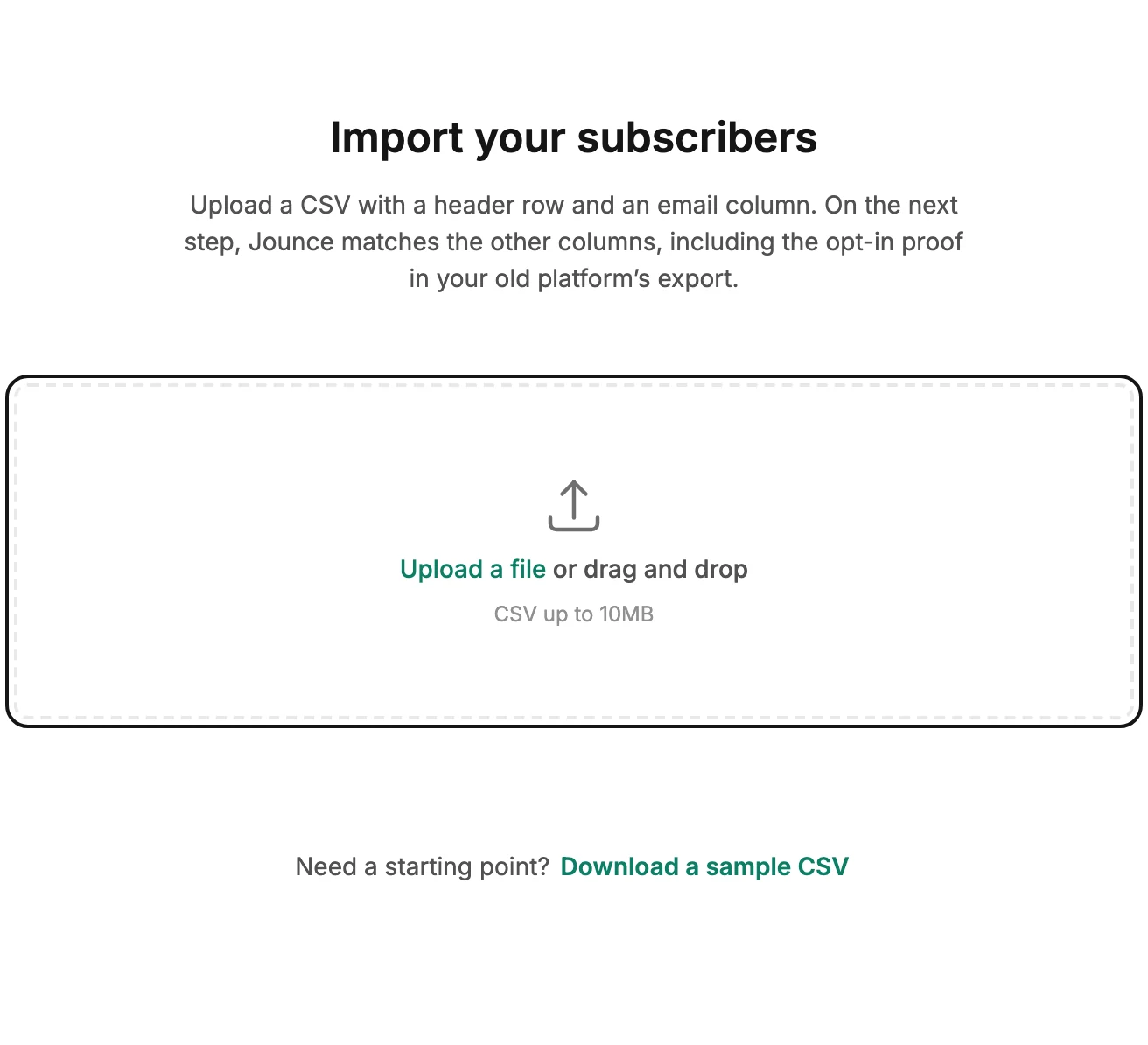
The heading says Upload your list. Select Upload a file to pick a CSV, or drag one onto the box. Under it, Download a sample CSV gives you a file in the right shape. Prepare your CSV file covers what the file needs. If the file is refused, see Why won’t my file import?
Match your columns
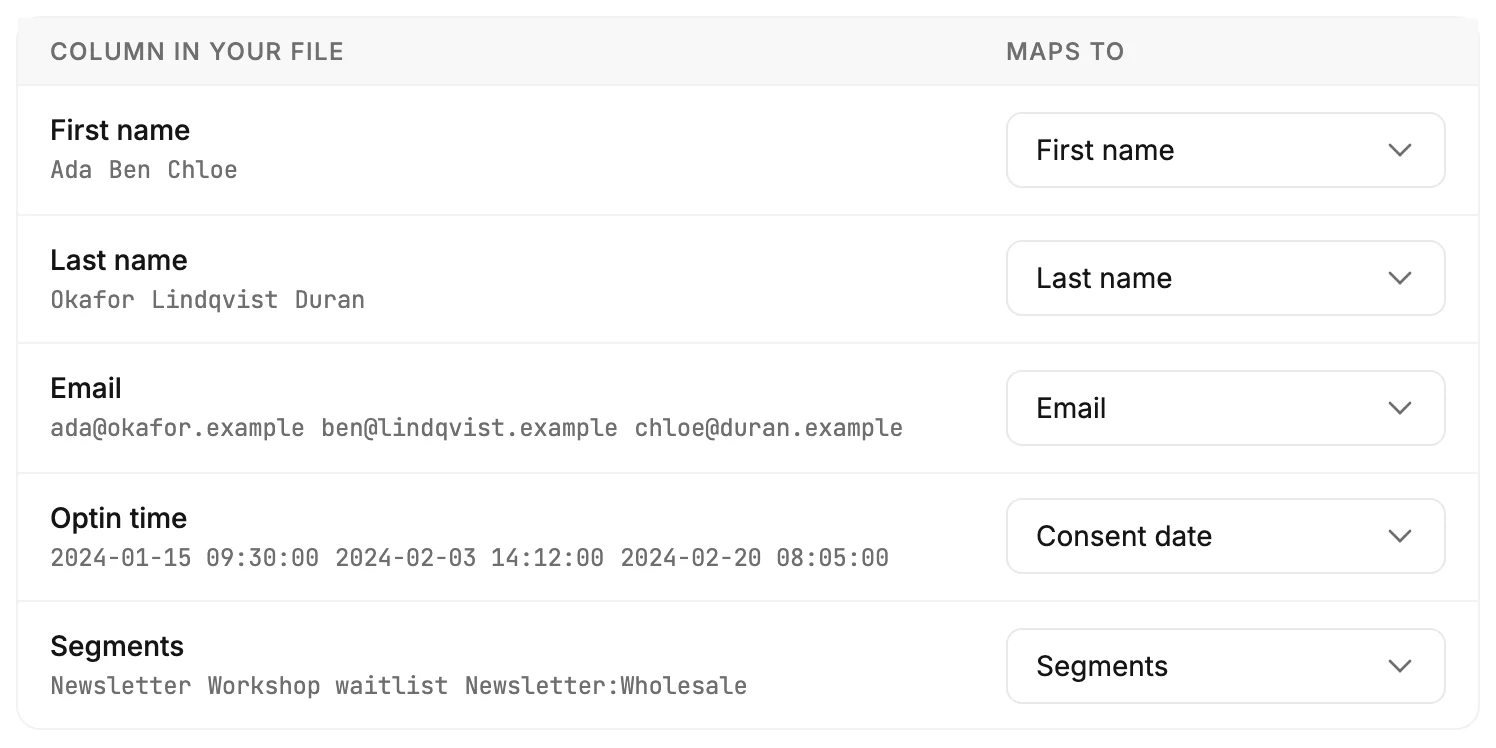
The step opens with Jounce matched what it could. The table has one row per column in your file. Column in your file shows the header and up to three sample values. Maps to is where that column goes:
| Maps to | What it becomes |
|---|---|
| Don’t import | Nothing. The column is left out. |
| First name | The person’s first name. |
| Last name | The person’s last name. |
| Their address. This is how Jounce tells people apart, so one column must map here. | |
| Segments | The segments they join, by name. The next step offers to create any you don’t have yet. |
| Consent date | The date they opted in, kept as their opt-in date. |
| Keep as proof | Stored as-is under the column’s own name, on each new contact’s record. |
| Status | The status your other tool gave them. Only a row it marks active, or leaves blank, comes in. |
| Your custom fields | A value on their page, under that field. |
| Create new field… | Opens a small dialog to name a field, then maps the column to it. |
If no column maps to Email, the step says so: Match a column to Email to continue — it’s how Jounce knows who’s who.
Below the table, When an email already exists offers Update their details and keep their history or Skip them. When an email already exists explains both. Last comes the permission statement: Everyone on this list asked to hear from me. No bought, rented, or scraped lists. Continue stays off until a column maps to Email and the statement is ticked.
Add them to a segment
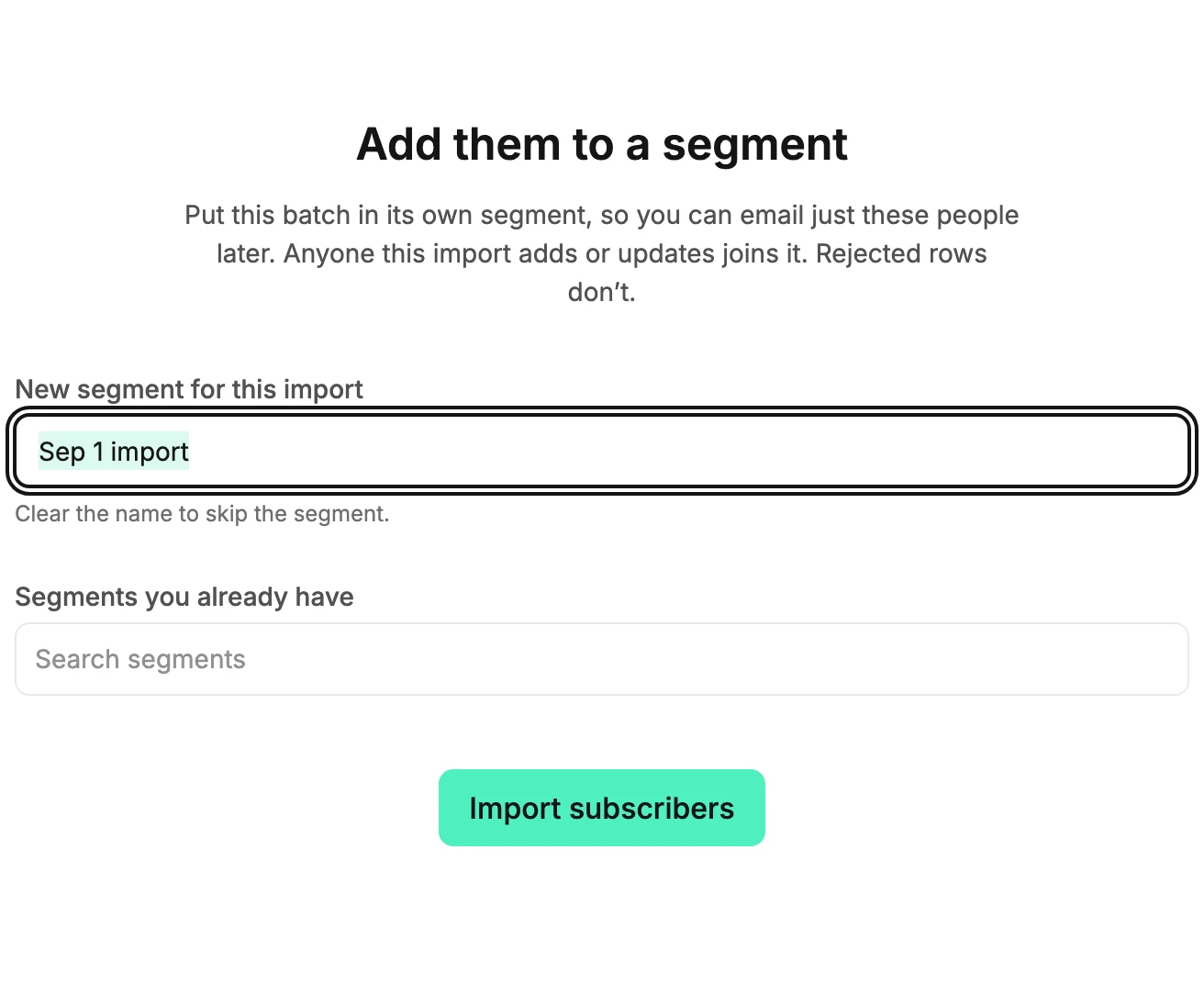
The step offers this import a segment of its own. You can find the batch later and send to just that segment. The name is filled in for you with today’s date, like Jun 26 import. Under it: Clear the name to skip the segment.
Segments you already have lets you pick more segments. Everyone the import adds joins them too. Import contacts starts the import.
When your file’s Segments column names segments you don’t have yet, a box under the picker names them, ticked from the start. Ticked, Jounce creates them before it adds anyone, and each person joins the ones their row names. Unticked, everyone still comes in, just not into those segments.
When a Manager or an Admin imports a file that marks people unsubscribed, bounced or spam, the step says so under the segments. It reads Your file marks 28 people as unsubscribed, bounced or spam. Jounce keeps them on your suppression list, so a later import can’t add them back.
A second line follows once Jounce has looked through your list: 3 of them are on your list now. The import changes their status to match, so they stop getting your emails. Import contacts waits a moment for that count.
Jounce may not be able to read your list. Then the line reads If any of them are on your list now, the import changes their status to match.
Why were some rows rejected? says what Jounce keeps.
While it imports
The heading reads Checking your addresses, then Adding your contacts. Three lines show the progress: Read your file — N rows, Checking addresses to protect your sending, and Adding your contacts to “…”. Under them: Your file stays safe until every row is in.
A long list skips this view, and so does a file whose opt-outs Jounce keeps. Instead the screen says Your list is importing, and Jounce emails you when it’s done. Imports that finish in the background has the details.
The summary
The headline says how it went: Your contacts are in when new people joined, Your list is up to date when everyone was already on your list, and Your import finished when some rows couldn’t be saved. They match the email Jounce sends for a big import.
One line under it says how many were new and how many were updated, and names the segment. When the file brought back people you had deleted, a second line says how many: 2 of these you had deleted are back on your list. They’re part of the updated count.
The line 2 rows repeated an email address — each address counts once means your file lists some addresses on more than one row. Jounce reads each of those addresses as one contact, so none is counted twice above.
Anything Jounce couldn’t take in shows below. N couldn’t be saved — try importing those again means a save failed. It’s safe to import the file again. N rejected lists why. Download the rejected rows gives you each address and its reason. See Why were some rows rejected? for each reason. Done closes the screen.
More in this topic
Also answered here
- what does maps to mean
- what does the status option do
- what happens while the import runs
Updated